Your Kitchen Wasn’t Designed for Your Brain — Here’s How to Fix It
By Deborah DiMare | DiMare Design
How much money did you throw away last month in food you forgot you had? Not forgot on purpose — forgot because it was in the back of the fridge, behind something in the pantry, or in one of those deep dark cabinets where things go to die.
That is not a you problem. That is a kitchen design problem.
And it has a name: object permanence. If your brain cannot see it, it does not exist. Most kitchens — most beautiful, expensive, well-intentioned kitchens — are designed in a way that fights your brain at every single turn. I have been designing luxury interiors for over twenty years, exclusively with non-toxic and ethical materials, and the kitchen is where I see the most dysfunction. And the most transformation when we get it right.
Here is exactly how.
The ADHD Kitchen Tax — And Why It Is Not Your Fault
There is a tax that many of us with ADHD — or honestly, most busy people — pay every single week. It is the spinach that turned to liquid in the crisper drawer. The three half-used jars of the same pasta sauce because you forgot you had the other two. The counter that was clean yesterday and is a doom pile today and you genuinely do not know how it happened.
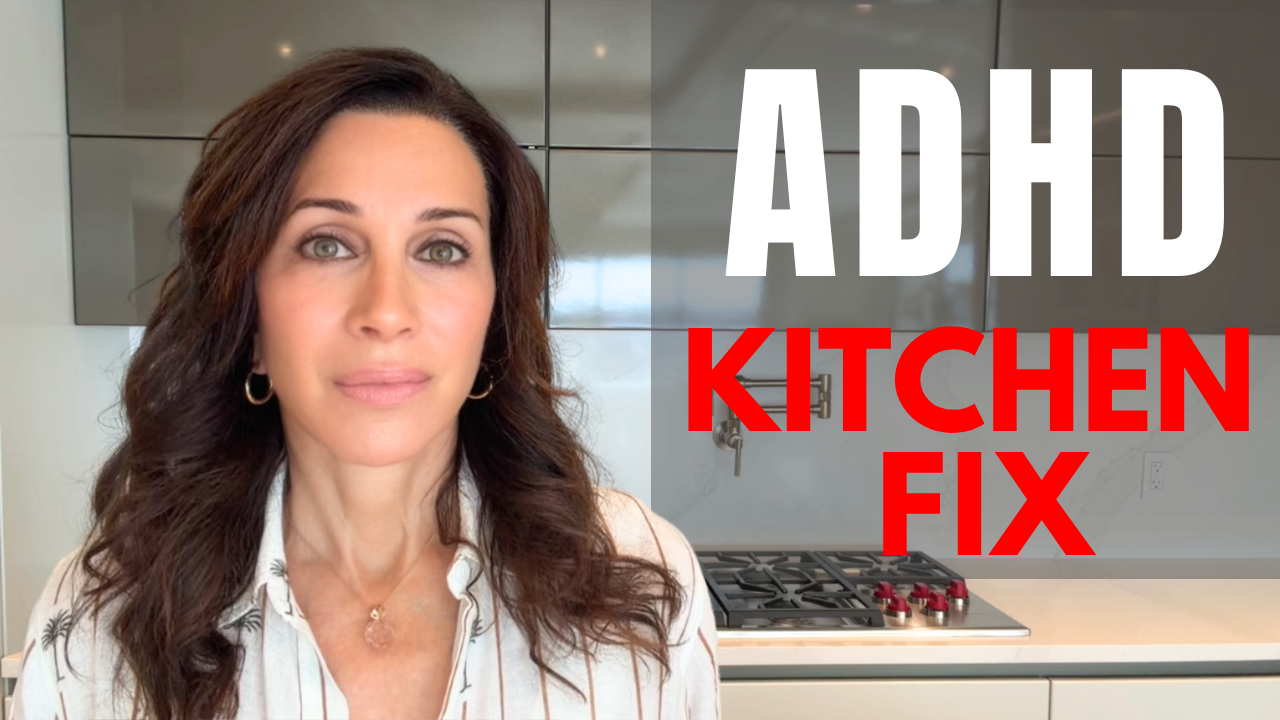
We call this the ADHD Kitchen Tax. The money lost, the food wasted, the mental energy spent managing a space that is constantly working against you.
Here is what I need you to hear: this is not a character flaw. It is bad matchmaking. Your kitchen was designed for a neurotypical brain that can remember what is behind a cabinet door, can tolerate a five-step process to put something away, and can visually filter out clutter without effort. One in five people are neurodivergent. That means in almost every household, there is a brain working significantly harder than it needs to just to function in the most-used room in the home. The kitchen design industry is almost entirely ignoring this.
I am not.
The Object Permanence Fix — Your Fridge and Pantry
The standard refrigerator layout is designed backwards for an ADHD brain. The things most likely to expire — fresh produce, prepped proteins, leftovers — are hidden in opaque bottom drawers or pushed to the back of shelves. The things that will outlive us all — condiments, sodas, sealed jars — get the prime real estate at eye level.
Flip it entirely. Move condiments and sealed jars into the crisper drawers. Put everything live — fresh produce, prepped vegetables, proteins, leftovers — at eye level on the main shelves in clear containers where your brain can actually register that they exist.
Use glass bins, not plastic. From a health perspective, conventional plastic storage containers — even BPA-free ones — can leach plasticizers into food, especially with temperature changes. Glass does not. From an ADHD perspective, glass is a visual invitation. When those bright strawberries are sitting at eye level in clear glass, your brain gets a small hit of dopamine. The healthy choice becomes the visible choice. And visible is everything.
The same principle applies in the pantry. Deep shelves with stacked boxes and lids are doom. Use open-front bins, stainless steel lazy Susans for oils and spices so you can see everything with one spin, and pull-out drawers inside cabinets if you are renovating.
The one-motion rule applies everywhere: if putting something away takes more than one motion — open a door, move a box, unscrew a lid — it is not going back where it belongs. Design for how people actually behave, not how you wish they would.
And ethically — glass storage manufactured without toxic coatings, from companies with transparent supply chains, is better for the workers who make it and better for the planet and animals. Non-toxic living and ethical sourcing are the same decision. They always are.
The Doom Surface — Countertops and the Visual Brain
Let’s talk about the doom surface. You know what I mean. The counter that started as a temporary spot for the mail, then the keys, then the thing you were going to deal with later — and now it is an archaeological dig of your last three weeks.
Kitchen counters are the number one doom surface in most homes because they have no designated purpose. They are everything surfaces. An ADHD brain uses the counter as its external hard drive — if it is important it goes on the counter so you don’t forget it. The problem is everything goes on the counter, so nothing gets found, and the visual chaos actively raises your cortisol every time you walk into the room.
The fix is not to tell yourself to keep it cleaner. The fix is a designated landing zone — one beautiful tray, one dedicated spot near the entry point of your kitchen, for things that are truly in transit. Everything else has a home somewhere else.
While we are talking about countertops — the material matters for your health, not just your aesthetic. Quartz, currently the most popular choice in luxury kitchens, is made from crystalline silica bound with petrochemical resins. Australia has moved to ban quartz fabrication for workers due to silicosis risk — a deadly, incurable lung disease. California is following. Those resins can also interact with acidic foods over time.
The cleaner alternatives I specify: natural quartzite — not quartz, quartzite — which is 100% natural stone with no resins. Soapstone, which is antibacterial, non-porous, never needs sealing, and literally heals its own scratches with mineral oil. And properly finished butcher block — solid hardwood, food-safe glue, pure tung oil finish.
The counter your brain calms down around and the counter that is safe to cook on are the same counter. That is always the goal.
The One-Motion Kitchen — Cabinetry and Low-Friction Design
Ever go to the kitchen for a spoon, see a dirty dish, start the dishwasher, then forget why you were in there? We call that side-questing. It happens because most kitchens require your brain to make too many decisions just to complete a simple task. An ADHD executive function system that is already working at capacity will abandon the mission every single time.
The solution is the one-motion kitchen. Every item you use daily should be reachable in one motion. Coffee station — mugs, spoons, coffee, all within twelve inches of the machine. Cooking zone — oils, spices, utensils, all within reach of the stove. No side-questing. No executive function detours.
For cabinetry — floor to ceiling closed storage wins over open shelving every time for an ADHD brain. Open shelves look gorgeous in a showroom. In a real kitchen they are a running to-do list your brain cannot turn off. Closed cabinetry with interior pull-outs and lighting inside the cabinet — so you can actually see what you have without hunting — gives your brain permission to rest.
One thing your cabinet supplier will never volunteer: most conventional cabinetry is made with glues that contain formaldehyde. That formaldehyde off-gasses into your kitchen air. There are two certifications that tell you the cabinets are safe. CARB Phase 2 — the US standard from the California Air Resources Board that limits formaldehyde emissions. And NAF — No Added Formaldehyde — which means none was used at all. One question to your supplier is all it takes. If they cannot answer it, that is your answer.
Biophilic Warmth — What Your Nervous System Is Actually Responding To
That kitchen you saw on Instagram last week — the one with the warm wood and soft lighting that made you stop scrolling — it was not just beautiful. Your nervous system was responding to something specific.
After years of cold grey kitchens, clients are returning to warmth. Soft natural wood grain finishes. Earthy organic tones. Materials that reference the natural world. This is biophilic design — and it is not a trend. It is neuroscience.
Brain imaging studies show that natural environments reduce activation in the amygdala — your brain’s threat detection center. Natural materials, warm tones, and wood grain patterns signal safety to your nervous system before conscious thought. Cortisol drops. Blood pressure drops. Attention restores.
For an ADHD brain specifically, this matters even more. A kitchen with cold industrial surfaces and visual complexity keeps the nervous system in alert mode. A kitchen with warm natural materials and visual calm is one where the brain can actually settle — where cooking feels like something you want to do rather than something you have to perform.
Every material choice also carries a supply chain. The shift toward natural certified materials — sustainable wood, stone without toxic resins, finishes with transparent chemistry — is better for the person living in the home and for the people who built it. Beautiful and ethical are not competing goals. They never have been.
The One Thing That Changes Everything — And It Costs Almost Nothing
Lighting.
Specifically — eliminating the big overhead light as your primary source. Bright, cool, overhead lighting activates your sympathetic nervous system. It puts your brain into performance mode — alert, vigilant, working. For a sensory-sensitive brain, and most ADHD brains are sensory-sensitive, a harshly lit kitchen is a kitchen your body wants to leave before you have started cooking.
Replace it with warm under-cabinet LEDs as your primary task light. A small warm lamp on the counter or island. Pendants tuned to 2700 Kelvin or lower — the warm amber end of the spectrum, not the cool blue-white that makes your kitchen feel like a hospital.
Clients tell me they cook more after we change the lighting. They clean more willingly. They linger in the kitchen just being there. Not because we renovated. Because we changed the light. LED strips are inexpensive and straightforward to install. That one change will tell your nervous system that the kitchen is a place to rest in, not just to perform in.
The Through-Line
Remember the ADHD Kitchen Tax? The food waste, the doom piles, the cycle of clean then chaos then clean again?
That tax is not your fault. It is a design failure. Your kitchen was built for a brain that is not your brain. The fix is not more discipline. The fix is a kitchen designed around how you actually function.
Glass storage at eye level. One-motion access to everything you use daily. A landing zone for things in transit. Non-toxic surfaces that don’t off-gas. Materials that signal safety to your nervous system. And lighting that makes the whole space feel like somewhere you want to be.
That kitchen — the one that supports your brain, protects your health, and was made by people treated fairly — is also the most beautiful kitchen I know how to design. Because when everything is working the way it should, it always looks right.
That is what good design does.
Deborah DiMare is a luxury non-toxic interior designer based in Miami. She designs exclusively with cruelty-free, toxin-free, and ethically sourced materials. Follow her YouTube channel Design Detox for weekly non-toxic design education. Her Amazon storefront — linked in every video description — features the products she actually specifies in client projects.
Deborah DiMare is a luxury non-toxic interior designer based in Miami. She has been designing with cruelty-free, toxin-free, ethically sourced materials for over twenty years. Follow her on YouTube at Design Detox.



Join our Facebook Community Design for a Non Toxic & Cruelty Free Home.
Check out our non-toxic and cruelty-free Amazon shop.
In case you missed it 🌸
Need help creating a safe & healthy home for you & your family?
BOOK US for a 20-minute call!
Need even more family-friendly home design tips?
Meghan Markle and her choice of nursery paint.
Read more about pesticide-free Gardening Know How
How a good desk chair will improve back pain.
How to protect our marine life ocean plastic.
Best Materials for a Kitchen Backsplash Remodel.
What are volatile organic compounds (VOCs)?
How time in nature can improve our mental health and sharpen our cognition?
Why should I be concerned about lead poisoning?
31 Kitchen Color Ideas to Elevate Your Cabinetry Without a Full Remodel.
Just a heads up, this article may contain links to affiliate sites, products or services. If you purchase something through one of those links, you won’t pay a penny more! The affiliate simply provides us with a small commission which helps us fund our operations, promoting healthy & compassionate interior decorating.

Share this with friends!

I’m Deborah! My mission is to show others by demonstration, that no living being, human & non, be sacrificed for beautiful, non toxic, healthy & durable furniture & decor. More about me.