Your coffee table may be the reason your living room still doesn’t look finished.
Not because you bought the wrong table. And probably not because you need more décor.
In fact, you may need less.
After years of designing interiors, I’ve found that most coffee table decorating mistakes come down to the same things: too many objects, everything at the same height, no variation in texture, accessories bought without a specific purpose, and not enough empty space.
A beautifully styled coffee table should look effortless. More importantly, it should still function for the people who actually live in the house.
So before you buy another vase, candle, tray, or coffee table book, try these eight interior designer rules.
1. Use the Rule of 3 When Decorating a Coffee Table
When a coffee table feels “off,” count the objects.
One of the simplest coffee table styling tricks is grouping accessories in odd numbers—especially three.
Three objects create movement. Your eye travels from one piece to another instead of seeing a rigid matched set.
Try a combination such as:
- A ceramic or stone vase
- A small stack of coffee table books
- A sculptural bowl
The objects don’t have to match. Actually, I prefer when they don’t.
I want a home to feel collected, not as though someone walked into a store and bought the entire display.
There are exceptions. Symmetry and pairs can be beautiful in ultra-modern interiors and certain formal spaces.
But if you’re stuck, start with three.
2. Use the Height Triangle: Tall, Medium, Low
Here is another reason coffee table décor can look wrong even when every individual piece is beautiful:
Everything is the same height.
Same-height objects visually flatten a table.
Instead, create what I call a height triangle.
Choose something tall, something medium, and something low.
For example, you might use a taller ceramic vessel, a medium sculptural object, and a low stack of books or decorative bowl.
I usually place the tallest piece first and build down from there.
This principle also helps you shop more intelligently.
Before buying another accessory, ask yourself: What job does this piece perform?
If you already own six medium-height accessories, you probably don’t need number seven.
You need contrast.
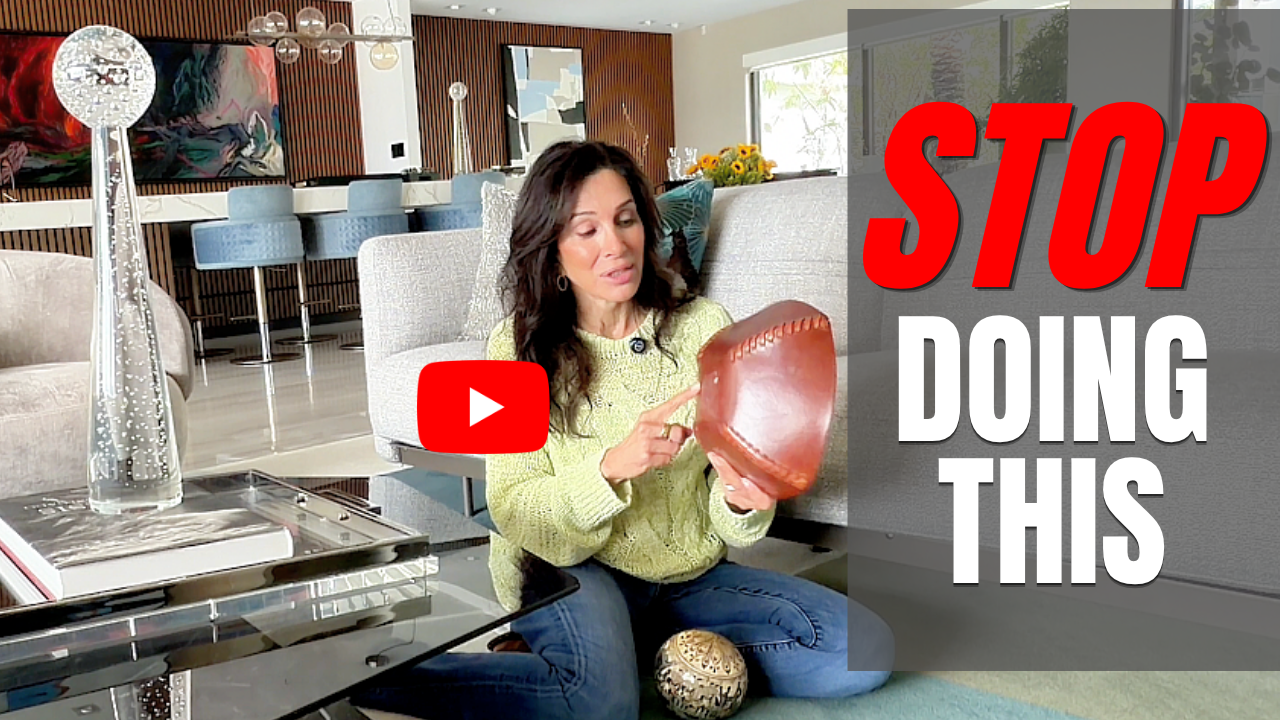
3. Check What Your Home Décor Is Actually Made Of
This is where my approach to interior design differs from conventional decorating advice.
I don’t believe an object belongs in your home simply because it’s beautiful.
I want to know what it’s made of.
Many decorative accessories and furnishings contain animal-derived materials such as leather, wool, fur, down, bone, and horn. Others may use synthetic materials designed to imitate them.
I prefer designing with materials such as wood, stone, glass, ceramic, natural clay, and thoughtfully sourced recycled or reclaimed metals.
Turn the accessory over. Read the label. Ask the manufacturer.
We spend enormous amounts of time choosing colors and finishes for our homes while often ignoring what those products are actually made from.
Your home can be beautiful while also reflecting your health priorities and values.
For me, those things are not separate from good design.
They are part of good design.
4. Leave More Empty Space Than You Think You Need
This may be my favorite decorating rule:
Negative space is one of the most luxurious things in a room.
People frequently assume that because a surface is empty, something needs to go there.
It doesn’t.
In fact, one of the fastest ways to make a beautiful coffee table look cheap is to cover every inch of it with little objects.
Instead of deciding where your accessories will go, reverse the process.
Decide what part of the coffee table you’re going to leave empty first.
Then decorate what remains.
That open area gives the objects you’ve chosen room to breathe. It also gives you room to breathe visually.
And there’s a practical benefit: you still have somewhere to put a drink, a snack, a game, or your feet.
If you own a lot of beautiful accessories, don’t display all of them simultaneously.
Rotate them.
Less really can do more.
5. Give Your Coffee Table the Touch Test
We talk constantly about what interiors look like.
I think we need to talk more about what they feel like.
We are sensory beings, and our homes are sensory environments.
So after styling a coffee table, I give it what I call the touch test.
Run your hand across the objects.
If everything feels the same, the arrangement may be missing something.
Mix tactile experiences: smooth stone, textured ceramic, warm wood, cool metal, glass, and plant-based textiles.
A great coffee table shouldn’t only make someone look.
It should make them want to reach out and touch something.
That’s when a collection starts feeling personal rather than staged.
6. Remember What a Coffee Table Is Actually For
This is the coffee table decorating rule people forget most often.
You still have to live around it.
For me, the goal of a coffee table isn’t to create a perfect photograph.
I want people gathered around it.
I want family and friends eating, talking, putting down drinks, picking up books, playing games and hanging out.
Think about your coffee table almost like the kitchen island of your living room.
It’s a nucleus.
If you want people to gather around it, design it for gathering.
That means leaving open space. It means using objects people aren’t terrified to touch. And it means resisting the urge to turn every square inch into a display.
Beautiful design should support life—not interfere with it.
7. Know When One Object Is Enough
Sometimes the best grouping is no grouping at all.
One spectacular object can be more powerful than five mediocre ones.
This is especially important when the surface itself already has a strong personality.
A sculptural stone table, dramatic console or piano doesn’t necessarily need a collection sitting on top of it.
The furniture may already be the art.
Before adding anything, ask:
What is this surface already contributing to the room?
If it’s already visually strong, try placing one sculptural object on it and stopping.
Yes, stopping.
That’s the part people have trouble with.
We’re conditioned to fill empty surfaces.
But empty space can be an intentional design decision.
8. Stop Buying Décor Without Knowing Where It’s Going
This rule will save you money.
Never buy an accessory without having some idea where it will live.
We’ve all done it.
You see a beautiful object in a store and think, I’ll find somewhere for it.
Then it comes home and joins the growing collection of beautiful things that don’t quite work anywhere.
Instead, shop for the room—not the store.
Take photographs of the coffee tables, consoles, shelves and other surfaces in your home that actually need something.
Keep those photographs on your phone.
When you’re shopping, look at the photograph before buying the object.
Ask yourself:
Where exactly is this going?
What does that location need?
Height? Texture? Color? Scale? Function?
If you can’t answer the first question, consider leaving the object in the store.
One Last Designer Trick: Photograph the Room
Your phone can reveal decorating mistakes your eyes have stopped seeing.
Stand at the entrance to your living room and take a photograph.
Now study the photo.
Pay particular attention to the first several feet of the room. Tall objects near an entrance can interrupt sightlines and make a room feel smaller.
Try keeping things lower near the doorway and introducing more height as your eye moves farther into the room.
Photographs are incredibly useful because we become accustomed to our own spaces.
The pile we’ve walked past for six months eventually becomes invisible to us.
The camera sees it.
So, What Should You Put on a Coffee Table?
There isn’t one perfect formula, but a beautifully styled coffee table might include:
- One taller vase or sculptural object
- Two or three coffee table books
- A low bowl or decorative object
- Contrasting natural textures
- Something personal or interesting
- Most importantly, empty space
You don’t need all of these.
Your table’s size, shape, material and purpose should determine how much décor it actually needs.
The Coffee Table Rule I Want You to Remember
If you remember only one thing from this article, make it this:
Stop thinking of your coffee table as a surface you need to fill.
Think of it as a place you want someone’s hand to reach for.
Every object should earn its place.
Maybe its job is height.
Maybe it’s texture.
Maybe it starts a conversation.
Maybe it holds the books you actually read.
Maybe it simply makes you happy every time you walk past it.
And sometimes the most important thing on your coffee table is the space where you put nothing at all.
That’s the difference between a room filled with beautiful things and a room that actually feels beautifully designed.
Frequently Asked Questions About Coffee Table Styling
How do I style a coffee table without making it look cluttered?
Start with fewer objects than you think you need. Vary their heights and textures, group smaller objects together, and deliberately leave part of the tabletop empty.
What is the rule of 3 for coffee tables?
The rule of three means arranging three objects or visual elements together. Odd-numbered groupings can create a more relaxed, dynamic composition than identical pairs.
What should every coffee table have?
There is no single object every coffee table needs. Start with how you use the table, then consider a combination of books, a vase, a bowl, or a sculptural object while preserving enough open space for everyday life.
How do I make my coffee table look expensive?
Don’t assume more décor creates a more luxurious look. Edit aggressively. Use fewer, more intentional pieces, incorporate varied heights and textures, avoid covering the entire surface, and let beautiful materials and negative space do some of the work.
Should coffee table décor match the rest of the room?
It should relate to the room without looking like a matching set. Repeat a material, shape, texture, or tone already present elsewhere while
Deborah DiMare is a luxury non-toxic, ethical (vegan) interior designer based in Miami and Hudson Valley, NY. Design Detox is a YouTube channel dedicated to beautiful, healthy, and ethically sourced interiors.



Join our Facebook Community Design for a Non Toxic & Cruelty Free Home.
Check out our non-toxic and cruelty-free Amazon shop.
In case you missed it 🌸
Need help creating a safe & healthy home for you & your family?
BOOK US for a 20-minute call!
Need even more family-friendly home design tips?
Meghan Markle and her choice of nursery paint.
Read more about pesticide-free Gardening Know How
How a good desk chair will improve back pain.
How to protect our marine life ocean plastic.
Best Materials for a Kitchen Backsplash Remodel.
What are volatile organic compounds (VOCs)?
How time in nature can improve our mental health and sharpen our cognition?
Why should I be concerned about lead poisoning?
31 Kitchen Color Ideas to Elevate Your Cabinetry Without a Full Remodel.
Just a heads up, this article may contain links to affiliate sites, products or services. If you purchase something through one of those links, you won’t pay a penny more! The affiliate simply provides us with a small commission which helps us fund our operations, promoting healthy & compassionate interior decorating.

Share this with friends!
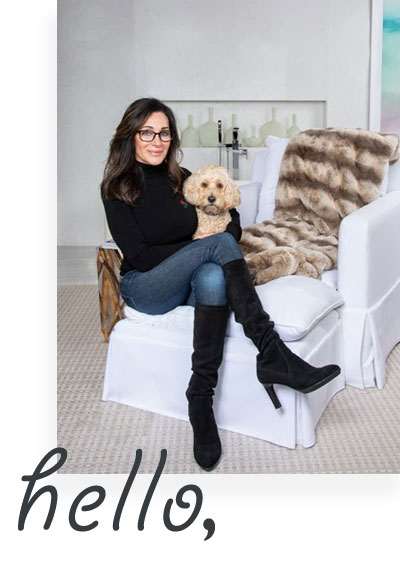
I’m Deborah! My mission is to show others by demonstration, that no living being, human & non, be sacrificed for beautiful, non toxic, healthy & durable furniture & decor. More about me.