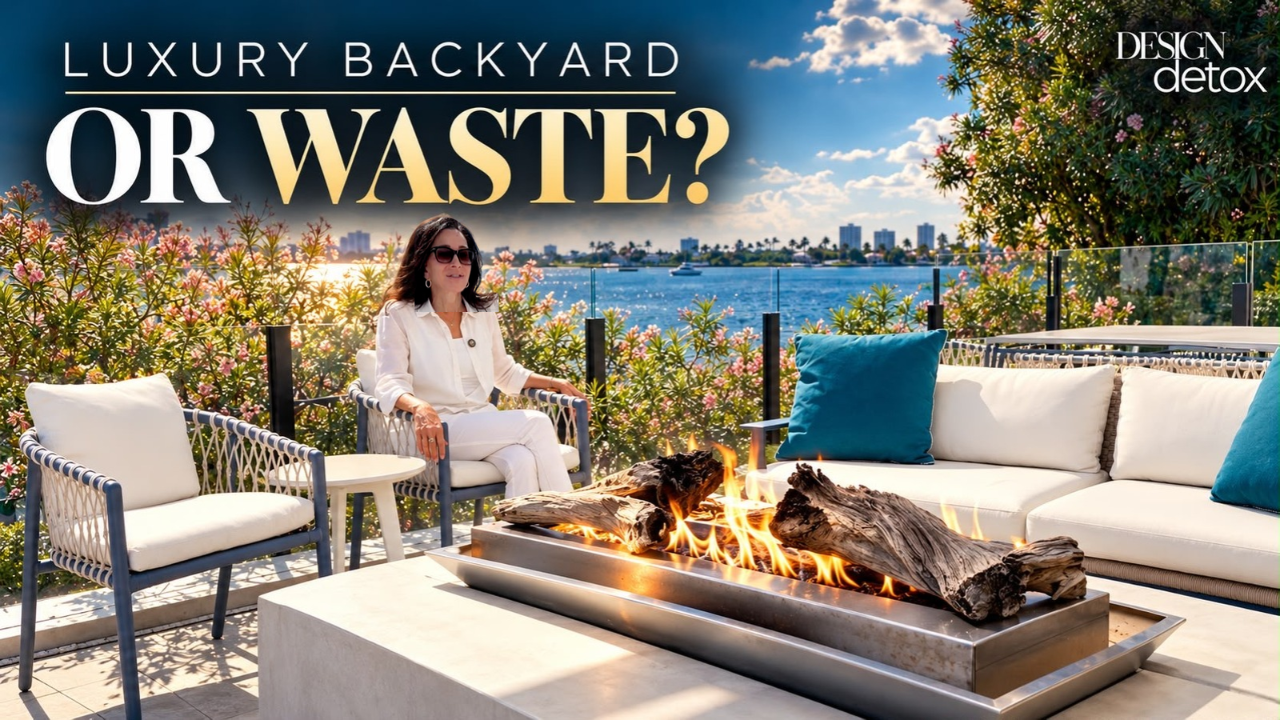
Some of the most expensive things people are putting into backyards right now are exactly what I tell my clients not to buy. I recently filmed in a stunning waterfront backyard in Miami, Florida and it reminded me how often luxury outdoor design follows trends instead of real life.
Below are seven backyard trends I think waste your money, followed by where I would invest instead. If you are planning a patio, pool area or full backyard renovation, read this before you sign a contract.
[Embed the YouTube video here]
1. The outdoor TV
Outdoor TVs have become almost standard in luxury outdoor design, and I understand why: football, movies, kids and entertaining.
The problem is what happens next. The sofa faces the TV, the chairs face the TV, and your beautiful outdoor living area becomes an indoor family room without walls. Meanwhile, the sunset is happening behind you.
If you have a view, the view is the screen. I would rather orient the furniture toward the view and toward each other. Designers call this sociopetal seating: seats arranged so people naturally face one another instead of all facing the same direction. Facing each other invites conversation in a way that facing a screen never will.
If you genuinely watch sports outside every weekend, design for your real life. If you only want a TV occasionally, conceal it:
- Behind weather-resistant cabinet doors
- Behind a sliding architectural panel
- On an outdoor-rated motorized lift that lowers it out of sight
- On a secondary wall, so it never becomes the focal point of the backyard
2. Artificial turf
Artificial turf looks fantastic. No mowing, no muddy paws and a perfect green carpet all year. If it is installed with proper drainage, pet urine can drain through.
But I would not automatically specify it, especially somewhere hot like Florida. A 2024 systematic review in the International Journal of Biometeorology found synthetic grass surfaces ran about 9 to 34 degrees Celsius hotter than natural grass. That matters for children, pets and bare feet.
There is also the plastic question. Studies have detected PFAS (the long-lasting “forever chemicals”) and phthalates (chemicals that make plastic soft and flexible) in some turf components. That does not mean every turf contains them, or that having turf means you are being harmed. The evidence on human health outcomes is still developing. It does mean you should ask manufacturers exactly what is in the product.
Better options, depending on your climate:
- Native or climate-appropriate groundcovers, low-growing plants that need less water and fertilizer once established
- Permeable hardscape or gravel in the right areas
- Real grass where you can maintain it responsibly
Many people also love the feeling of walking barefoot on real grass or sand, sometimes called grounding. The research behind grounding is limited, but the pleasure of it is real.
If turf truly solves a problem for you, ask four questions: What is in it? How hot does it get? How does it drain? What happens to it at the end of its life?
3. Elaborate water features
I love water in design. It creates movement, reflects light and sounds calming. But many backyards are now overloaded with waterfalls, fountains and spillways that make a space feel like a resort lobby rather than a home.
You are not only paying to install a water feature. You are also paying for pumps, cleaning, water treatment, electrical work and repairs, every year.
Before adding one, ask what experience you are trying to create. If you already have a natural feature, like a bay, a lake or mature trees, do not compete with it. Your senses are already taking in the movement, the breeze and the light. Sometimes the most calming design decision is subtraction.
4. The overbuilt fire pit
Huge built-in fire pits and conversation pits look beautiful on Instagram. The real question is how often you will use one. Picture yourself out there: what time of day, which days, how many times a year? In a warm climate, the honest answer may be a handful of evenings.
There is a health side too. According to the U.S. Environmental Protection Agency, fine particles like those in smoke can get deep into the lungs, and some may even reach the bloodstream. Smoke can be especially hard on children, older adults and people with heart or lung conditions.
If you love fire, and many of us do, keep it appropriately scaled and safely placed:
- Put it in a genuinely open location, not a tight enclosed space
- Check the prevailing wind so smoke does not blow into your seating or the house
- Keep it away from combustible furniture and plants
- Follow the manufacturer’s clearances from walls, ceilings, overhangs and decking
When I meet new clients, I ask them to walk me through a weekday, from the moment their feet touch the floor until they get back into bed, and then a weekend day. Do you have coffee outside? Do the kids swim after school? Do you grill on Saturdays? Design around the life you actually live, not the one a photograph suggests.
5. Choosing the wrong outdoor materials
This is where people make some of the most expensive mistakes. Natural materials are wonderful, but sometimes you have to be practical about budget and maintenance. If you cannot keep up with natural wood, a good composite decking deserves consideration.
The right outdoor material depends on sun, water, salt, humidity, heat, snow and ice, how long you are keeping the home, and how much maintenance you will actually do.
When choosing composite decking, look for:
- Transparency about exactly what is in the board
- Recycled-content claims verified by third parties such as GreenCircle or SCS Global Services
- An Environmental Product Declaration (EPD), a standardized report of the product’s environmental impact
- FSC-certified wood content, if the composite contains wood fiber
None of these automatically makes a product non-toxic, but they give you far more transparency than vague “eco-friendly” language. And remember that dark composite can get very hot underfoot.
For outdoor fabrics, look past the words “performance fabric”:
- OEKO-TEX Standard 100 means the finished textile was tested for a long list of harmful substances
- GOTS matters when the fabric is actually made from certified organic fibers
- GOLS covers organic latex, not fabric, so it only applies to cushions or components with latex
- Ask whether any PFAS were intentionally added for water or stain resistance
For frames, aluminum and high-quality stainless steel are durable and resist corrosion. With powder-coated metal, ask what is in the coating.
My simplest advice: take the sample outside. Put it in the sun, wet it and touch it when it is hot. Outdoor materials live a much harder life than indoor ones. A material is not luxurious if you are constantly fighting it.
6. Designing for the photo instead of real life
This may be the biggest mistake on the list. Perfect white chaise lounges and sculptural daybeds arranged around the pool look incredible. Then it is 94 degrees, the sun is directly overhead, your drink is warm, and after seven minutes you are back inside.
Good outdoor design starts with the human body. Where is the sun at noon, at two and at five? Where is the breeze, and where is the glare? How far do you walk for a drink? Can you sit comfortably for an hour?
Light matters beyond temperature, too. Natural daylight, especially in the morning, helps set your circadian rhythm, the roughly 24-hour internal clock that shapes when you feel alert and when you feel sleepy. You do not need to bake in the sun to get it. Sitting in open shade outdoors still gives you far brighter light than most indoor spaces.
That is why I love a motorized shade. It can completely change how often you use a backyard. The same goes for substantial, commercial-grade umbrellas that are properly anchored. On a waterfront, an umbrella has a job to do, and a flimsy decorative one will be dancing across the patio at the first breeze.
7. Where I would actually spend the money
After telling you what to skip, here is where I would invest:
- Shade. Motorized shades, architectural overhangs or well-positioned umbrellas. If a space is not comfortable, you will not use it.
- Great seating. Not twelve mediocre pieces, but four to six fantastic ones you actually want to nap in, read in or curl up in with your cuddle buddy, human or otherwise.
- The dining area. This is where memories happen: dinner with friends, morning coffee, wine at sunset. Choose an extendable table and chairs that are comfortable but easy to move. Position it so every seat gets a view of water or greenery.
- The cooking area. If you cook outside regularly, invest in task lighting, prep space, storage, durable counters, ventilation and safe clearances.
- The view. Your landscape plan, furniture and architecture should lead the eye to one extraordinary experience, not seven competing focal points.
The big idea: design for how you live
When you design your backyard, do not ask what is trending. Ask how you want to live out there. Will you eat, swim, read, nap or entertain? Do your kids play there, and does your dog run there? Where do you need shade, what gets hot, and which materials require chemicals or constant maintenance?
That is the difference between decorating an outdoor space and designing one. Your home and your body work as one system, and good design takes care of both.
Frequently asked questions
Is artificial turf bad for pets? Not automatically. Well-drained turf can handle pet urine, but synthetic surfaces can get much hotter than natural grass, so check surface temperature before letting pets play on it in the sun.
Is an outdoor TV worth it? Only if you will regularly watch outside. Otherwise, conceal it in a cabinet, behind a panel or on a lift so it does not dominate the space.
What is the best non-toxic outdoor fabric? Look for OEKO-TEX Standard 100 certification and ask for fabrics made without intentionally added PFAS. Some solution-dyed acrylic outdoor fabrics offer both.
What backyard upgrades add the most value to daily life? Shade, comfortable seating, a well-placed dining area and a functional cooking zone. These are the features people use every week.
Work with me
If you are reading this and thinking, “How would this work in my home?” I would love to help. I work with clients everywhere, virtually, so it does not matter where you live. Whether you want fewer chemicals in your home, cruelty-free furniture that lasts, or a space designed around your family’s health, [book a consultation here].
Sources: International Journal of Biometeorology systematic review, 2024 · U.S. EPA, Particulate Matter Basics · AirNow, How Smoke From Fires Can Affect Your Health
3. Elaborate water features
I love water in design. It creates movement, reflects light and sounds calming. But many backyards are now overloaded with waterfalls, fountains and spillways that make a space feel like a resort lobby rather than a home.
You are not only paying to install a water feature. You are also paying for pumps, cleaning, water treatment, electrical work and repairs, every year.
Before adding one, ask what experience you are trying to create. If you already have a natural feature, like a bay, a lake or mature trees, do not compete with it. Your senses are already taking in the movement, the breeze and the light. Sometimes the most calming design decision is subtraction.
4. The overbuilt fire pit
Huge built-in fire pits and conversation pits look beautiful on Instagram. The real question is how often you will use one. Picture yourself out there: what time of day, which days, how many times a year? In a warm climate, the honest answer may be a handful of evenings.
There is a health side too. According to the U.S. Environmental Protection Agency, fine particles like those in smoke can get deep into the lungs, and some may even reach the bloodstream. Smoke can be especially hard on children, older adults and people with heart or lung conditions.
If you love fire, and many of us do, keep it appropriately scaled and safely placed:
- Put it in a genuinely open location, not a tight enclosed space
- Check the prevailing wind so smoke does not blow into your seating or the house
- Keep it away from combustible furniture and plants
- Follow the manufacturer’s clearances from walls, ceilings, overhangs and decking
When I meet new clients, I ask them to walk me through a weekday, from the moment their feet touch the floor until they get back into bed, and then a weekend day. Do you have coffee outside? Do the kids swim after school? Do you grill on Saturdays? Design around the life you actually live, not the one a photograph suggests.
5. Choosing the wrong outdoor materials
This is where people make some of the most expensive mistakes. Natural materials are wonderful, but sometimes you have to be practical about budget and maintenance. If you cannot keep up with natural wood, a good composite decking deserves consideration.
The right outdoor material depends on sun, water, salt, humidity, heat, snow and ice, how long you are keeping the home, and how much maintenance you will actually do.
When choosing composite decking, look for:
- Transparency about exactly what is in the board
- Recycled-content claims verified by third parties such as GreenCircle or SCS Global Services
- An Environmental Product Declaration (EPD), a standardized report of the product’s environmental impact
- FSC-certified wood content, if the composite contains wood fiber
None of these automatically makes a product non-toxic, but they give you far more transparency than vague “eco-friendly” language. And remember that dark composite can get very hot underfoot.
For outdoor fabrics, look past the words “performance fabric”:
- OEKO-TEX Standard 100 means the finished textile was tested for a long list of harmful substances
- GOTS matters when the fabric is actually made from certified organic fibers
- GOLS covers organic latex, not fabric, so it only applies to cushions or components with latex
- Ask whether any PFAS were intentionally added for water or stain resistance
For frames, aluminum and high-quality stainless steel are durable and resist corrosion. With powder-coated metal, ask what is in the coating.
My simplest advice: take the sample outside. Put it in the sun, wet it and touch it when it is hot. Outdoor materials live a much harder life than indoor ones. A material is not luxurious if you are constantly fighting it.
6. Designing for the photo instead of real life
This may be the biggest mistake on the list. Perfect white chaise lounges and sculptural daybeds arranged around the pool look incredible. Then it is 94 degrees, the sun is directly overhead, your drink is warm, and after seven minutes you are back inside.
Good outdoor design starts with the human body. Where is the sun at noon, at two and at five? Where is the breeze, and where is the glare? How far do you walk for a drink? Can you sit comfortably for an hour?
Light matters beyond temperature, too. Natural daylight, especially in the morning, helps set your circadian rhythm, the roughly 24-hour internal clock that shapes when you feel alert and when you feel sleepy. You do not need to bake in the sun to get it. Sitting in open shade outdoors still gives you far brighter light than most indoor spaces.
That is why I love a motorized shade. It can completely change how often you use a backyard. The same goes for substantial, commercial-grade umbrellas that are properly anchored. On a waterfront, an umbrella has a job to do, and a flimsy decorative one will be dancing across the patio at the first breeze.
7. Where I would actually spend the money
After telling you what to skip, here is where I would invest:
- Shade. Motorized shades, architectural overhangs or well-positioned umbrellas. If a space is not comfortable, you will not use it.
- Great seating. Not twelve mediocre pieces, but four to six fantastic ones you actually want to nap in, read in or curl up in with your cuddle buddy, human or otherwise.
- The dining area. This is where memories happen: dinner with friends, morning coffee, wine at sunset. Choose an extendable table and chairs that are comfortable but easy to move. Position it so every seat gets a view of water or greenery.
- The cooking area. If you cook outside regularly, invest in task lighting, prep space, storage, durable counters, ventilation and safe clearances.
- The view. Your landscape plan, furniture and architecture should lead the eye to one extraordinary experience, not seven competing focal points.
The big idea: design for how you live
When you design your backyard, do not ask what is trending. Ask how you want to live out there. Will you eat, swim, read, nap or entertain? Do your kids play there, and does your dog run there? Where do you need shade, what gets hot, and which materials require chemicals or constant maintenance?
That is the difference between decorating an outdoor space and designing one. Your home and your body work as one system, and good design takes care of both.
Frequently asked questions
Is artificial turf bad for pets? Not automatically. Well-drained turf can handle pet urine, but synthetic surfaces can get much hotter than natural grass, so check surface temperature before letting pets play on it in the sun.
Is an outdoor TV worth it? Only if you will regularly watch outside. Otherwise, conceal it in a cabinet, behind a panel or on a lift so it does not dominate the space.
What is the best non-toxic outdoor fabric? Look for OEKO-TEX Standard 100 certification and ask for fabrics made without intentionally added PFAS. Some solution-dyed acrylic outdoor fabrics offer both.
What backyard upgrades add the most value to daily life? Shade, comfortable seating, a well-placed dining area and a functional cooking zone. These are the features people use every week.
Work with me
If you are reading this and thinking, “How would this work in my home?” I would love to help. I work with clients everywhere, virtually, so it does not matter where you live. Whether you want fewer chemicals in your home, cruelty-free furniture that lasts, or a space designed around your family’s health, [BOOK A FREE CONSULTATION].
Sources: International Journal of Biometeorology systematic review, 2024 · U.S. EPA, Particulate Matter Basics · AirNow, How Smoke From Fires Can Affect Your Health
Deborah DiMare is a luxury non-toxic, ethical (vegan) interior designer. Deborah works with clients virtually and on location within the USA. Design Detox is a YouTube channel dedicated to beautiful, healthy, and ethically sourced interiors.



Join our Facebook Community Design for a Non Toxic & Cruelty Free Home.
Check out our non-toxic and cruelty-free Amazon shop.
In case you missed it 🌸
Need help creating a safe & healthy home for you & your family?
BOOK US for a 20-minute call!
Need even more family-friendly home design tips?
Meghan Markle and her choice of nursery paint.
Read more about pesticide-free Gardening Know How
How a good desk chair will improve back pain.
How to protect our marine life ocean plastic.
Best Materials for a Kitchen Backsplash Remodel.
What are volatile organic compounds (VOCs)?
How time in nature can improve our mental health and sharpen our cognition?
Why should I be concerned about lead poisoning?
31 Kitchen Color Ideas to Elevate Your Cabinetry Without a Full Remodel.
Just a heads up, this article may contain links to affiliate sites, products or services. If you purchase something through one of those links, you won’t pay a penny more! The affiliate simply provides us with a small commission which helps us fund our operations, promoting healthy & compassionate interior decorating.

Share this with friends!

I’m Deborah! My mission is to show others by demonstration, that no living being, human & non, be sacrificed for beautiful, non toxic, healthy & durable furniture & decor. More about me.